Customer Success or Failure @ Scale


For many years, “Customer Success at Scale” has been the rallying cry. But let’s say the quiet part out loud: we’ve scaled failure. Not because we didn’t try hard enough, but because we scaled from the inside out. We optimized for our metrics, not their meaning. We chased SLAs and efficiency, and we sacrificed trust.
Why scaling from the inside-out is breaking trust and how communities can put it back together
For the past two decades, “scale” has been the corporate incantation: push more customers through the funnel, deflect more tickets, automate more touchpoints, and save more costs. Ideally without anyone noticing the seams. We call it Customer Success @ Scale. But let’s be honest: more often than not, what we’ve actually built is Customer Failure @ Scale.
Not because we’re incompetent. But because we’ve taken an inside-out approach of optimizing for internal efficiency, SLA compliance, and executive dashboards, while asking customers to adapt to our systems instead of the other way around. In other words: we scaled operations, not relationships.
And now, we’re turning to AI to finish the job.
Inside-out scaling: the comfort of control
Inside-out scaling is seductive. It promises predictability:
- Automated response emails to meet SLA clocks regardless of whether the response helps
- Outsourced support to reduce costs regardless of whether quality drops
- Chatbots designed to deflect contact reducing volume, not frustration
- AI assistants taking over “moments and ways of contact”, multiplying touchpoints without multiplying trust
The result? Customers feel like numbers, not relationships. Emotional connection and trust erode. This approach stretches thinly across the customer experience like plastic wrap. It keeps things contained, but it doesn’t nourish. And the more we stretch it, the easier it tears.
The community frontier and the new temptation
Online customer communities were supposed to be different. They promised belonging, peer-to-peer knowledge, advocacy, and co-creation. But the inside-out mindset is bleeding in here too: AI content generation, automated moderation, synthetic engagement prompts, and “smart” summaries designed to collapse nuance into convenience.
Let’s be clear: None of these are inherently bad. AI can be a powerful tool. But the question is not “Can AI help?” It’s “What are we trying to optimize and at what cost?”
Community is getting dragged into the efficiency machine. AI is moderating threads, generating recaps, surfacing “similar posts,” even auto-replying with “suggested solutions.” Useful, indeed. But if we’re not careful, we turn communities into transactional knowledge deflection layers by polite chatbots with profile pictures.
A real community isn’t just a place to find information. It’s a place to be seen, to share lived experience, to test ideas, to ask “am I the only one?” and hear “you’re not.” It’s a space for meaningful inefficiency: stories, contradictions, follow-ups, detours. Because humans don’t resolve complexity with a single perfect answer. We metabolize it with dialogue.
People don’t seek perfection. They seek belonging.
When people reach out to customer service and hit a chatbot wall, how often do they instantly type: “talk to a human”? We all know the answer. Because when stakes are high, when something’s broken, when context is messy, when emotions matter, people want to be heard, not processed.
In communities, it’s even more stark. The point of a community is not the mere transfer of information. If it were, a knowledge base would suffice. Communities serve the human need for emotional bond. People crave relationships built on trust and authenticity. Communities thrive on emotional engagement, not just information exchange.
Communities exist because inefficiency is a feature, not a bug. Why? Threads meander. People contradict each other. Stories emerge. Trust forms - over time - through imperfect interactions.
The intent of a community is not perfection at scale. It’s imperfect human beings interacting with one another, learning, helping, disagreeing, and choosing to come back anyway, to show up for one another. That’s belonging. That’s how loyalty is built. And that inefficiency is precisely what makes the community human.
The Long Tail: the beginning vs. the tip of the tail
AI shines on the beginning of the long tail of information. The repetitive questions, the evergreen FAQs, the “how do I reset…” and “where do I find…” queries. Use it there. Please do!
But at the tip of the tail are complex edge cases, nuanced context, emotional stakes, strategic decisions, relationship repair. And there AI falls short. Not because it can’t produce words, but because it can’t carry the weight of trust. Trust isn’t a response or an answer. It’s a relationship. Building fans and engaged members requires empathy, creativity, and human nuance.
Communities live at that tip of the tail. They are where people come to be seen, not just served.
The risk: transactional communities
If we let AI dominate the community, we risk creating purely transactional communities that are busy, responsive, efficient, and … hollow. We get activity without advocacy, speed without substance, answers without allegiance. We already see huge visit declines in communities of this transactional nature. As a consequence there is a decline in engagement and ultimately no original human content from your previously most active and engaged members. Because the zero search is taking away their audience, why should they bother to create any content? The result: further spiralling of decreasing visitor and engager numbers.
Scaling “engagement” is not the same as building community. Genuine engagement emerges when people experience social safety, feel that their contribution matters, and are met with empathy when things go wrong. No model can simulate that on its own. If AI dominates community interactions, will communities lose their soul?
A different premise: 5 outside-in by design tips
Let’s flip the premise. Assume outside-in thinking as the default:
- Start with emotional needs
What do customers need to feel to stay here? Safe, respected, listened to, part of something. - Decide what to automate and why
Automate to remove friction from low-stakes tasks, not to avoid contact in high-stakes moments. - Protect human bandwidth for high-value moments
Save your best community managers, moderators, and advocates for nuance, conflict, and care. - Design for relationship signals, not just interaction metrics
Track: Who returns to help? Who welcomes newcomers? Who repairs misunderstandings? Who reframes debates? These are the behaviours that build culture and brand equity. - Use AI as augmentation, not substitution
- Summarize threads to reduce cognitive load but always link to full context.
- Surface related discussions but spotlight human voices and narratives.
- Flag risk signals but let humans make judgments.
- Translate and transcribe but invite cultural interpretation from real members.
“But we need to scale”
Of course you do. But scale without soul is a revolving door: customers leave, then your acquisition machine spins faster, and your efficiency playbook tightens. That’s not scaling success. That’s scaling replacement.
True scale looks like this: AI handles repetitive queries so humans don’t burn out. Humans handle emotional and complex moments so trust deepens. Communities become habitats (not help desks) where customers help each other, mentor newcomers, and normalize the messiness of real-world use.
This is not anti-AI. It’s pro-human. It’s recognizing the difference between processing and connecting, between information and meaning.
Inefficiency is a feature, not a bug
We need to re-learn a simple truth: inefficiency is a feature in human systems. Consider aspects like this: The time it takes for someone to craft a thoughtful response. The extra posts that say “same here,” which validate feelings even if they duplicate data. The side conversations that build weak ties that later become strong ones. The open-ended explorations that don’t “resolve” but still teach.
Our communities don’t fail because they are inefficient; they fail when we try to sterilize them. Perfection is a control fantasy. Belonging is a social reality.
The hard questions we must ask
If you lead Customer Success, Customer Support, Community, or Product, ask yourself:
- Are we designing to prevent contact or to deepen relationships?
- Where are we using AI to reduce cost and where are we using it to increase care?
- Do our dashboards celebrate deflection or advocate development?
- Are we proud of our speed and embarrassed by our humanity?
If your answers sting, good. Growth begins with discomfort.
A practical reframe: 6 guidelines for AI + Community, done right
Here’s a grounded way forward:
- Map the experience by stakes
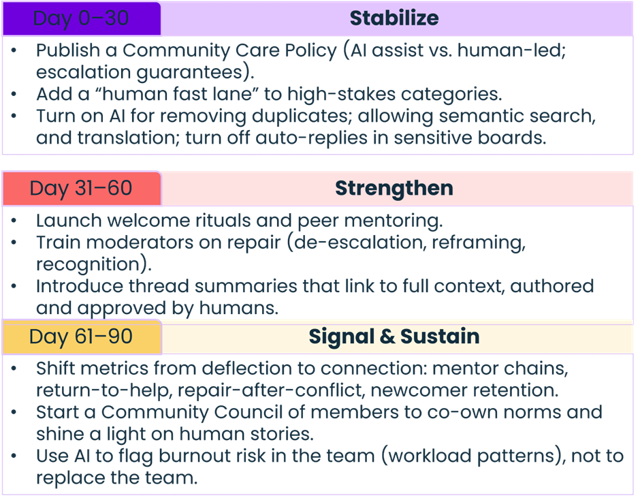
High-stakes moments (outages, billing disputes, complex implementations) get human-first pathways. Low-stakes moments get AI-first pathways. - Publish a “Community Care Policy”
Make it explicit: where AI assists, where humans lead, how escalation works, and how members can request human help at any time. - Invest in community roles as strategic assets
Community managers aren’t content janitors, they’re trust architects. Treat them accordingly. - Measure connection, not just activity
Track mentorship chains, welcome ratios, thread resolution quality, post-return rates, and repair signals after conflict. - Use AI to make humans more present, not more absent
- Draft summaries so moderators can engage deeper
- Suggest replies to speed response but let humans add tone and care
- Flag burnout risk by workload so teams can rest and remain human
- Scaling has been the holy grail for decades, but has it truly been customer-centric?
- Normalize imperfection
Celebrate authentic posts, acknowledge uncertainty, and model “we’re learning together.” This is the texture of trust.
Summary: choose belonging over efficiency
We didn’t get into community work to optimize dashboards. We did it to build places where people matter and where brands earn the right to be trusted.
AI is a powerful tool for scale. Use it. But do not mistake scale for success. And do not let inside-out thinking hollow out the very thing your customers are desperate to find: relationships that are messy, human, and real.
If you must choose, choose belonging over perfection. Because in communities - unlike machines - inefficiency is a feature, not a bug.
Craft your AI field-ready plan 30-60-90 days