From ‘Great Drought’ to 600 daily users: Building Ideagen’s community Luminate


During the fifth edition of this year’s Community Leaders Forum, Samuel Brown (Digital Platform Specialist) and Alan Blair (Senior CX specialist) took us along their journey of building Ideagen’s online community Luminate.
What they shared during this session was no ordinary story. After a period of no community, engagement or conversation starting in 2019, they decided to build a community from scratch in 2022. It had to serve users of over 50 different software products across multiple industries and it continues to expand today.
Four years later, the community is mature and lively. What makes Ideagen’s story particularly relevant is not just the scale, but the constant change. With new products, acquisitions and shifting customer needs, the challenge wasn’t simply to build a community, but to build one that could continuously adapt.
During the meetup, they shared how they approached the complexity of building a multi-product community, and what successes, challenges and learnings shaped Luminate into what it is today.
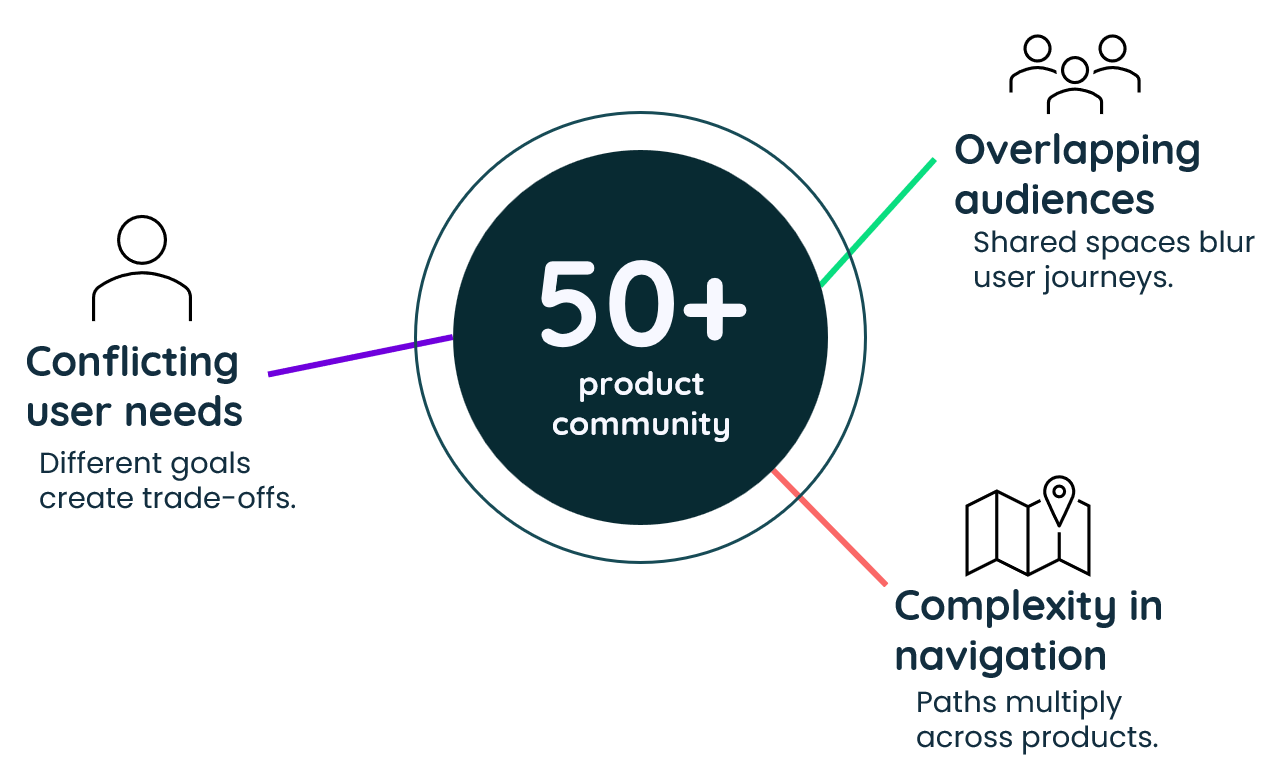
The reality of a 50+ product community
The origin, the great drought, and the (re)launch
Ideagen is a B2B software company that provides governance, risk and compliance tools to organisations in highly regulated industries like aviation, healthcare, manufacturing, and life sciences. Through various acquisitions, the product portfolio is constantly expanding. Alan originally managed a community within one of those acquired organisations. That community, launched in the early 2010s, focused on a single product and operated independently. After the acquisition, the community was retired and its role was absorbed into Ideagen’s central multi-product customer portal.
However, in 2019 the customer portal shut down. Alan referred to this as the start of the ‘great drought' as there was zero community, conversation or engagement. An extra layer of silence was added in 2020 when Covid hit. The in-person events that were the only remaining engagement between Ideagen and their users also vanished.
The silence lasted for two years, and as time went on, the need to bring back the conversation with their users became dire. In 2022, they made the decision to bring back the community and Samuel got involved. Despite it being a foreign discipline for him, Samuel was asked to start from scratch and build a community for the entire product suite within eight months.
The challenges before and during the launch
Spoiler alert: despite these challenges, the deadline was met and the community was up within 8 months! But, as you can imagine, building a community from scratch within 8 months doesn’t go without hurdles.
Single person team
A challenge that we frequently hear in the Community Leaders Forum is that there’s only one or two people in the Community team. For Samuel, this was no different. With a tech background and many shiny features, he got sucked into configuring things that they’d never use and wouldn’t drive engagement. He had lots of ideas, but no plan or way of working to rely on.
Scaling too fast, difficult timing
With the intention to create communities across the entire product suite, they skipped over the idea of perhaps starting with one product first, see what works and what doesn’t and go from there. Additionally, the world was coming off the back of a global pandemic and a lot of key customers had moved on from the previously existing customer portal, so rallying up early adaptors was not possible.
Competing services and dual use of terminology
Community was already part of the company’s core values as an existing initiative for charity and fundraising efforts at Ideagen. This was communicated internally and externally. This arose confusion when they first launched under the name ‘Ideagen Community’.
Additionally, Ideagen’s already existing help and support self-service space had about 1000 unique visitors a day, so customers already had a place to go. Although there was good content there, they were missing out on peer insight and discussion. This meant that there were two audiences, two platforms and both only got half of the picture. Since Alan was responsible for the upkeep of the self service space, this is where he and Samuel crossed paths. Samuel booked in a meeting with Alan, they shared ideas and eventually decided to make the help and support visitors aware of the new community.
Learnings and Adaptations that led to the big re-launch
As they joined forces, Alan and Samuel had the intention to build a unified experience while letting the Community grow alongside the already existing support services. The help and support service was reaching 1000 people, but it was nowhere near their full customer base. A lot of their customers didn’t know that these services existed, and those who did were dealing with separate URLs for each service. This eventually made them take a step back and ask themselves;
Why are we trying to make help, support and community work as completely separate things when the problem is that they're separate in the 1st place?
When this question came into the conversation, they reshaped the separate services into one unified experience with one place for customers to go to access the entire self-service landscape. Additionally, they changed the name from ‘Ideagen Community’ to ‘Ideagen Luminate’ to create something completely unique from what they already had.
Bringing people along: starting from within first through launch events
Before they could bring customers on the journey, they needed to bring their own people along with them first. They had a very simple strategy; to get staff excited, turn them into true believers, and then let them be the ones that go out to customers and champion Luminate.
You can't sell enthusiasm if you don't have it.
They did some merch drops, hosted both on- and offline events and identified internal influencers and champions. The energy it created was exactly what they wanted, because when internal people care and are excited about something, it starts to spread and customers start to hear about it.
A challenge that faced now is creating that same excitement for new staff. Other Community Leaders in the meeting shared that they try to make community a part of the hiring process and finding an element of the Community that resonates with them. Alan shared that they made Luminate part of mandatory training in the online learning portal.
The rebrand pay-off and best takeaway learnings
Before the rebrand the community had an average of 100-200 daily visitors in 2024. When they re-launched it, the daily visitors spiked up to 700 and are stable at 600 visitors since. They stumbled along the way, but always got back up and brought themselves closer to the Community of today. To conclude their session, they shared the most impactful takeaways;
- Stop competing with yourself - When multiple services serve a similar purpose, bringing them together can create a stronger, more effective solution.
- Engage Employees - Selling the benefits of the community to employees like you would to your customers is of great value. In the end, they are the ones to recommend it to a customer
- Adapt and Learn - Learn from experience and adjust the tactics, try and try again and don’t be afraid to try something new
- Reward and Recognition - Showing appreciating for engaged members (both internally and externally) goes a long way. Besides members feeling valued, it has the extra benefit of creating a kind of fear of missing out.
- Maximise your tooling - They've built the community using the tech that was already available to them. They emphasise that you don't need to know how to build complex, integrated experiences for customers. Just start simple.
Ideagen’s journey shows that building a community at scale isn’t about getting it right the first time. It’s about continuously reshaping it to fit a business that never stands still.
Four years later, Luminate is up and running and provides value to their users on a daily basis. Their story shows that.