Your members are decaying on schedule. And that’s a good thing.


At the September edition of the Community Leaders Forum (CLF), we welcomed Jillian Bejtlich, Director of Community & Developer Advocacy at Tines, for a thought-provoking session that challenged one of the most common assumptions in community management: is declining engagement always a problem?
Drawing inspiration from an unlikely source, nuclear physics, Jillian introduced a fresh perspective on member engagement and retention. Her central message was both simple and provocative: Sometimes members disengage because the community succeeded, not because it failed.
Rather than immediately asking how to bring inactive members back, Jillian challenged us to ask a different question: What if declining engagement is actually evidence that the community delivered value?
Members join a community, ask questions, build connections, and learn. Over time, as they become more confident with the product, their engagement naturally starts to decline. As Community Managers, we often see this decline as something to prevent or fix.
Most community professionals have experienced it. A dashboard shows declining participation, leadership becomes concerned, and suddenly discussions start about re-engagement campaigns, win-back initiatives, gamification, or new incentives.
The universal experience of having to explain
With over 20 years of experience in the community space, Jillian has seen how universally Community Leaders are expected to explain declining engagement, regardless of their platform, industry, or team size. A downward trend in the engagement dashboard often triggers the same question like; “what’s going wrong?,” “how do we get members back?”.
What if we look at decay as a sign of success
This may sound strange, because we don't generally want to see something decaying. We associate decay with something bad. Though she learnt that over time, members are decaying on schedule.
We’re not losing people because we failed them, but because they succeeded
Although Jillian understands the panic, she argues that this response overlooks the important distinction that members may not be disengaging because the community has failed them, but because they have gained the knowledge and confidence they came for.
Your re-engagement campaign is (almost always) a waste of money
In those cases where members got what they came for, investing in re-engagement campaigns may be not be as beneficial. She clarifies that this is based on assumed variables such as average use case and skill level (users), whether you are in a B2B, SaaS or similar industry, and when the community use case is primarily support and information.
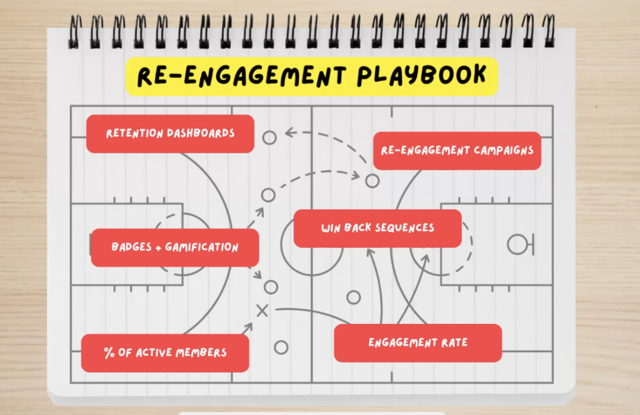
When we observe member decay, the playbook that we all know involves things such as:
- retention dashboards
- re-engagement campaigns
- win-back sequences
- badges and gamification
And all these tactics assume the exact same thing: engagement should be a stable state and that we should be maintaining that. It makes us believe that a member going quiet is actually a problem that we need to solve.
We treat engagement like a sport. But it’s not. It’s a science.
Jillian introduces us to a different mental model to look at engagement, borrowed from nuclear physics.
Radioactive decay describes how unstable atoms lose energy over time. In the formula below. A is how much mass you start with, X is how much time has passed, and Y is how much energy you have left at any given moment.
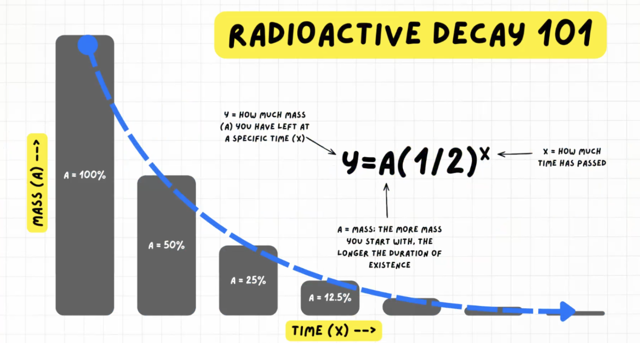
The key insight with this formula is that the curve that you see is always predictable. The shape doesn't change based on how hard you try to stop it. And more importantly, the more mass you start with, the longer the substance exists before it becomes negligible. We would never look at an atom of plutonium, see it go down and say that it failed. It’s decaying on a schedule. And it’s a good thing it is!
Translating it back to community. We swap “mass” with “need”.
To make the formula applicable to the work that we do, Jillian has swapped out mass for need.
Members join a community with a very specific need. This might be because they're uncertain about your product, they have unanswered questions or there's workflows they haven't figured out. In B2B especially, this need is often super high at the start when members are new to the product and are trying to get value quickly to get their work done.
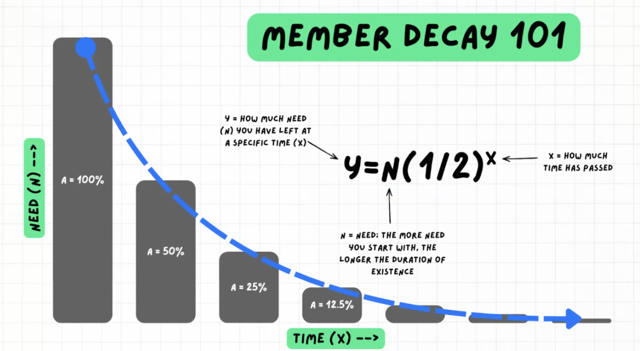
The more need that they arrive with, the longer their meaningful community engagement window is.
What's amazing about this model, is that the curve is predictable. It's not random, although most of us have been treating it as a mystery.
Uncertainty manifests in different ways
When asked whether this only applies to support and knowledge based communities, Jillian uses a personal example to answer. She recently bought her dream vehicle and when she knew that this was going to happen, she immediately joined a sub-Reddit about 4 runners. She asked many questions, because she had high uncertainty.
Then a few weeks ago, she realised she hadn’t visited the 4 runner community for about six months. So even though Jillian identifies herself as a super fan, her uncertainty (need) decayed, confidence increased and this changed how she interacted with the community.
A win back campaign is more like emotional attachment
The green zone in the visual below is the early high need period. In terms of marketing, communications or product life cycle, we often talk about the 30, 60, 90 day renewal period. But the reality is that this little block right here is a small window that opens extremely early in a customer's life cycle and closes on it’s own schedule.
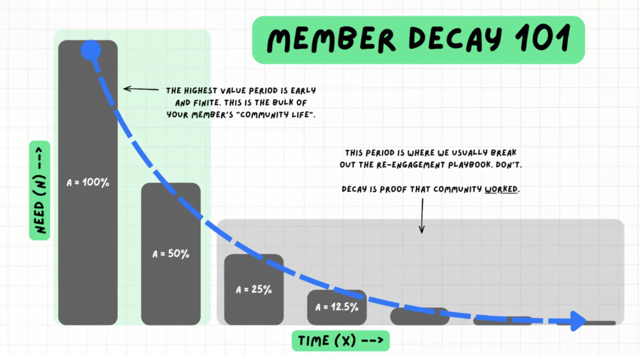
The grey zone is usually where we break out the re-engagement playbook because we see people not coming back as often. We’re interpreting this as a problem. If they're disengaged because they've learned what they needed to learn, you have actually done your job.
Running a win back campaign to pull them back into a community where they've actually graduated from isn't community management. It's more like emotional attachment.
Healthy versus unhealthy decay, how do we distinguish between the two?
A key distinction Jillian made was between healthy and unhealthy member decay.
That distinction matters. Instead of trying to reignite engagement indiscriminately, communities should focus on understanding:
- Whether members achieved their goals.
- Whether product or customer experience issues are creating disengagement.
- Whether a new need has emerged.
- Whether awareness of community resources remains strong.
The only reliable way to understand why members stop participating is to talk to them. Rather than immediately launching re-engagement campaigns, Jillian recommends reaching out with curiosity. The purpose is not to convince people to return, but to understand what happened.
As she shared from her own experience at Tines, many former contributors explain that they simply found what they needed. Their questions were answered, their knowledge increased, and they no longer had a reason to visit regularly. That kind of disengagement is very different from a member leaving because of frustration, poor experiences, missing content, or unmet expectations.
You cannot effectively re-engage a dissatisfied member until you understand and address the reason for their dissatisfaction.
When community teams take the time to have these conversations, they gain valuable insight into whether declining participation is a symptom of a problem or evidence of success. When a single member tells you about their dissatisfaction, this isn’t what you want to hear. But when many other members are sharing satisfaction, it’s important to design for those who are going to engage with your community.
As several CLF participants pointed out, reminders can still be valuable. However, they are most effective when they align with a genuine need rather than being sent as a blanket campaign to everyone.
Three things to stop
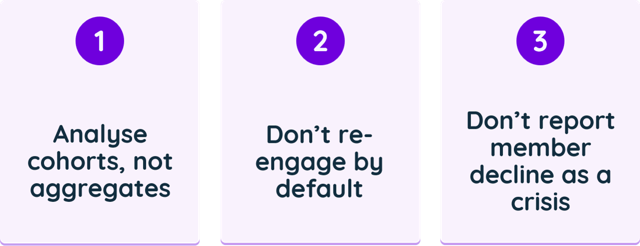
- Analyse cohorts, not aggregates: this is a big mistake Jillian sees a lot of people make. Don’t aggregate members without context. Looking only at total participation numbers can hide important trends. Comparing different member groups and stages in the customer journey provides much richer insights. An example drawn from her own experience is that while she was setting up the community, the metrics of the first month looked glorious. The second month, the metrics took a nosedive. Without adding the context that in the first month the internal cohort was actively pushing content on the platform, the metrics look like failure. It wasn’t. They were giving their members a moment to breathe and after that the engagement gradually climbed up again.
- Don’t re-engage by default: Just because engagement is dipping, doesn’t mean something is wrong. It can actually be a sign of a successful customer lifecycle, so the campaign might not be worth it. A better, alternative, first step is to understand what is going on first.
- Don’t report member decline as a crisis: Besides you and your manager, no one else knows what those numbers look like because they're not important. Even if you are to see a member decline, which you will, you should not report it as a crisis. It’s better to try and understand it. You can still talk about it, make a cohort analysis and provide that context. If there is actually something that you do need to address, address it intelligently.
Measuring value, not activity
The conversation quickly moved toward metrics, a topic familiar to every community leader. Many organisations still focus heavily on member counts and participation statistics. While these numbers have their place, Jillian argued that they rarely tell the full story. Instead, communities should focus on measuring outcomes that matter both to members and to the organisation.
One particularly powerful example shared by Jillian showed that customers who engaged with a previous community programme were significantly less likely to churn after one year. These are the kinds of metrics that resonate with executives because they connect community activity directly to business outcomes.
Community growth begins with better onboarding
If re-engagement isn't always the answer, what should community leaders focus on? Jillian offered several practical recommendations.
Four things to start
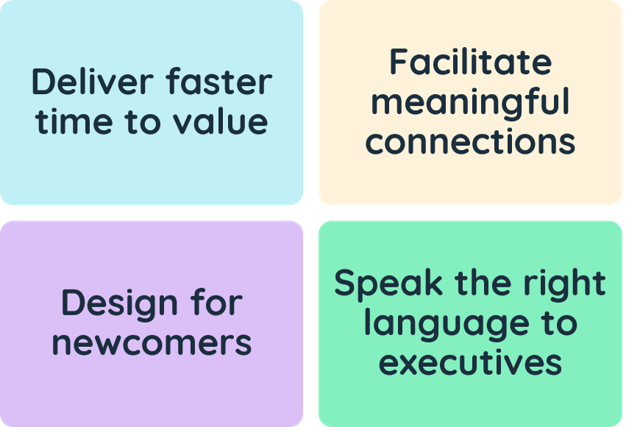
- Deliver faster time to value: the time between I just got to this community and I've got something real out of it is super important. Avoid any confusion at the start of the customer lifecycle. The faster members find answers, resources, or meaningful interactions, the stronger their initial experience becomes.
- Facilitate meaningful, intentional connections: relationships that are formed in the first 90 days are really the ones that stick. Jillian has experienced this herself with communities that she is a part of. She will continue to be part of those communities from her entire life because of the relationships that she found in those first 90 days.
- Design for newcomers: early-stage members have different needs than long-time experts. Community content and programmes should reflect that reality. We usually want to celebrate the super cool stuff that our members are doing, the really advanced things. But the reality is that a lot of times that is missing the target of our early stage members.
- Speak the right language to executives: make sure that you're speaking the right language, using organisational terminology for success, but also think about how you're presenting things. Don't say that engagement is down for September, instead say, this cohort's participation rate is different than the last cohort. You're not asking leadership to care less about numbers, you're just asking them to care about better ones.
When is a community truly dead?
One of the final questions explored a topic many community managers quietly struggle with: when is it time to let a community go? Jillian's answer was refreshingly pragmatic. A community should continue as long as there is shared value for both members and the organisation. When that shared value disappears, it may be time to close, merge, or reinvent the space. While this can be an uncomfortable decision, it also creates opportunities to invest resources in new and emerging community needs.
Key takeaway
Perhaps the most important lesson from this CLF session was that community professionals should not automatically interpret declining participation as failure. Engagement is rarely linear. Communities exist to help people achieve outcomes, and sometimes success means members no longer need to participate as actively as they once did.
As Jillian concluded:
Decay is inevitable. Poorly designed communities are not.
A big thank you to Jillian Bejtlich for sharing this fascinating perspective and to all CLF participants for contributing examples, questions and insights that made the discussion so valuable.
We look forward to seeing everyone at the next Community Leaders Forum.