MCPs, AI and the Future of Community Management


At the latest Community Leaders Forum meetup, we welcomed Julian Lindhorst, Community Strategy Director at Gainsight, for a practical and thought-provoking session on Model Context Protocols (MCP), AI-powered community management, and the evolving role of community professionals.
The discussion moved well beyond AI hype. Instead, attendees explored how AI can help community teams spend less time on repetitive administration and more time creating value through strategy, relationships, content, and member engagement.
What is an MCP?
For those new to the concept, an MCP (Model Context Protocol) can be thought of as a bridge between an AI assistant and another platform. It enables the AI to securely access data and perform actions within tools such as community platforms, CRMs, helpdesks, or collaboration systems.
Put on the spot, Julian described MCPs as a way to give AI assistants access to specific "tools" such as:
- Searching community content
- Analysing user activity
- Creating or updating content
- Managing moderation workflows
- Generating reports and insights
The result is a conversational way to interact with community data instead of manually exporting reports, building spreadsheets, or navigating multiple dashboards.
Most people are still very much at the beginning of their MCP and AI journey
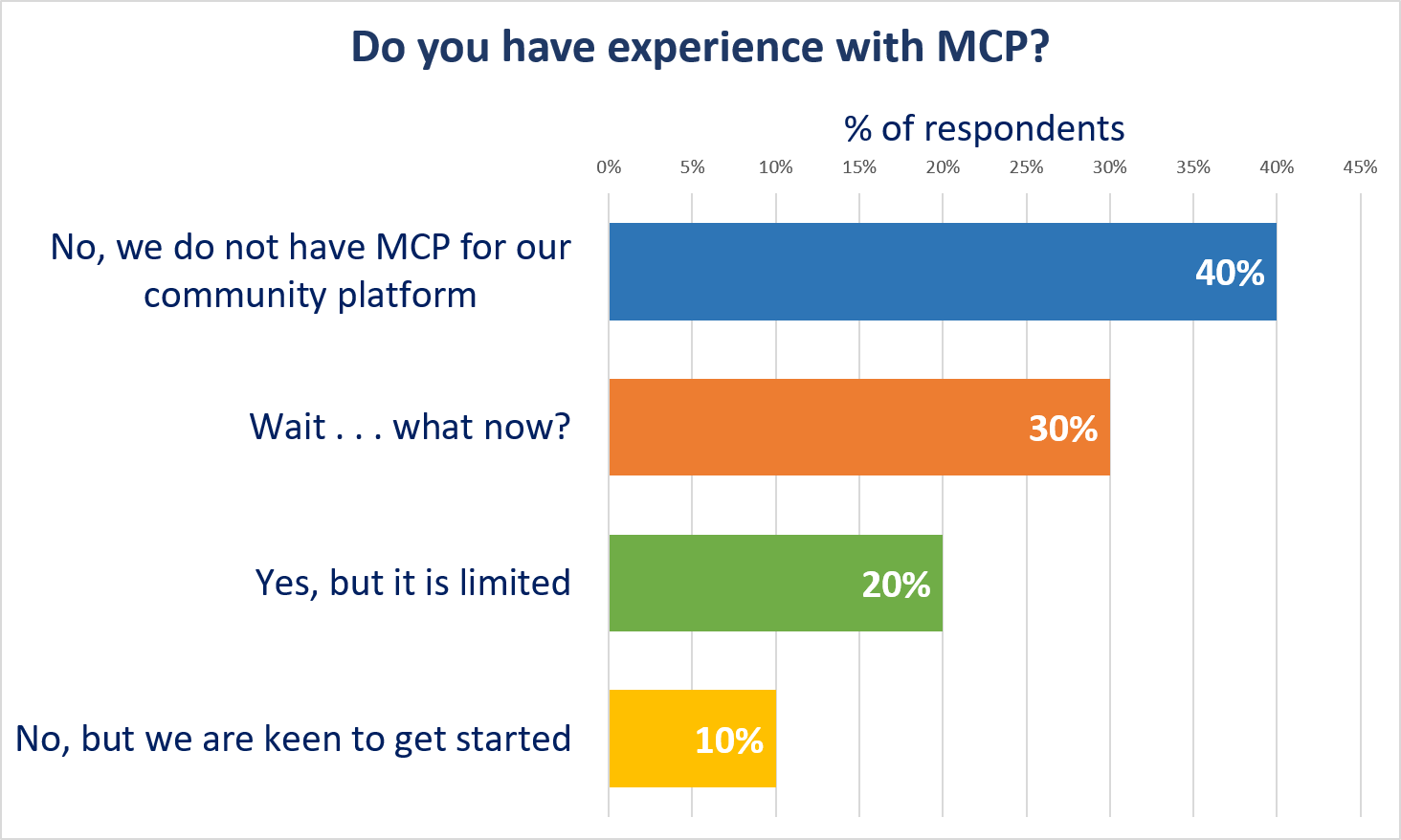
Before diving into possibilities, participants were asked about their familiarity with MCPs. The results highlight how early the market still is. While 20% reported some limited experience with MCPs, 40% indicated they did not yet have MCP capabilities available in their community platform, and another 30% admitted the concept was entirely new to them. Only 10% were actively exploring implementation. This reinforces why education and experimentation remain important first steps for many community teams.
The biggest opportunity: removing community manager busywork
Throughout the session, one message came through clearly: AI is not about replacing community managers. It's about eliminating tasks that consume time without creating much value.
Examples discussed included:
- Automated reporting and trend analysis
- Moderation queue triage
- Identification of unanswered questions
- Detection of emerging super users
- Category and taxonomy reviews
- Community health assessments
- Draft content generation and content gap analysis
Rather than spending hours compiling reports or reviewing thousands of posts, community managers can increasingly ask natural-language questions and receive actionable insights within seconds.
Interestingly, when participants were polled on where they saw the biggest value, automated reporting and manual analysis reduction emerged as one of the most attractive use cases.
What would justify investment in MCP?
When asked what outcomes would justify investment in MCP, two priorities clearly stood out: time saved on reporting and manual analysis (70%) and better identification of content gaps (70%). Community leaders also valued the ability to bring more community insights into Product, Customer Success and Support functions (50%). These results suggest that organisations are primarily looking for MCPs to increase insight and reduce operational effort, rather than simply automate actions.

Governance remains the biggest hurdle
While the technology is advancing rapidly, organisational readiness remains a challenge.
During the discussion, participants identified several barriers to adoption, including:
- Governance and compliance requirements
- Permissions and access management
- Taxonomy and content structure quality
- AI token and operating costs
- Security reviews and IT approval processes
Julian noted that technically enabling an MCP is often straightforward. Obtaining approval from IT, compliance, and security teams can take significantly longer. Many organisations are still evaluating how AI should access customer data and business systems.
The consensus was clear: successful adoption requires not only technology but also governance, transparency, and trust.
What needs to be done first before organisations get started with MCP?
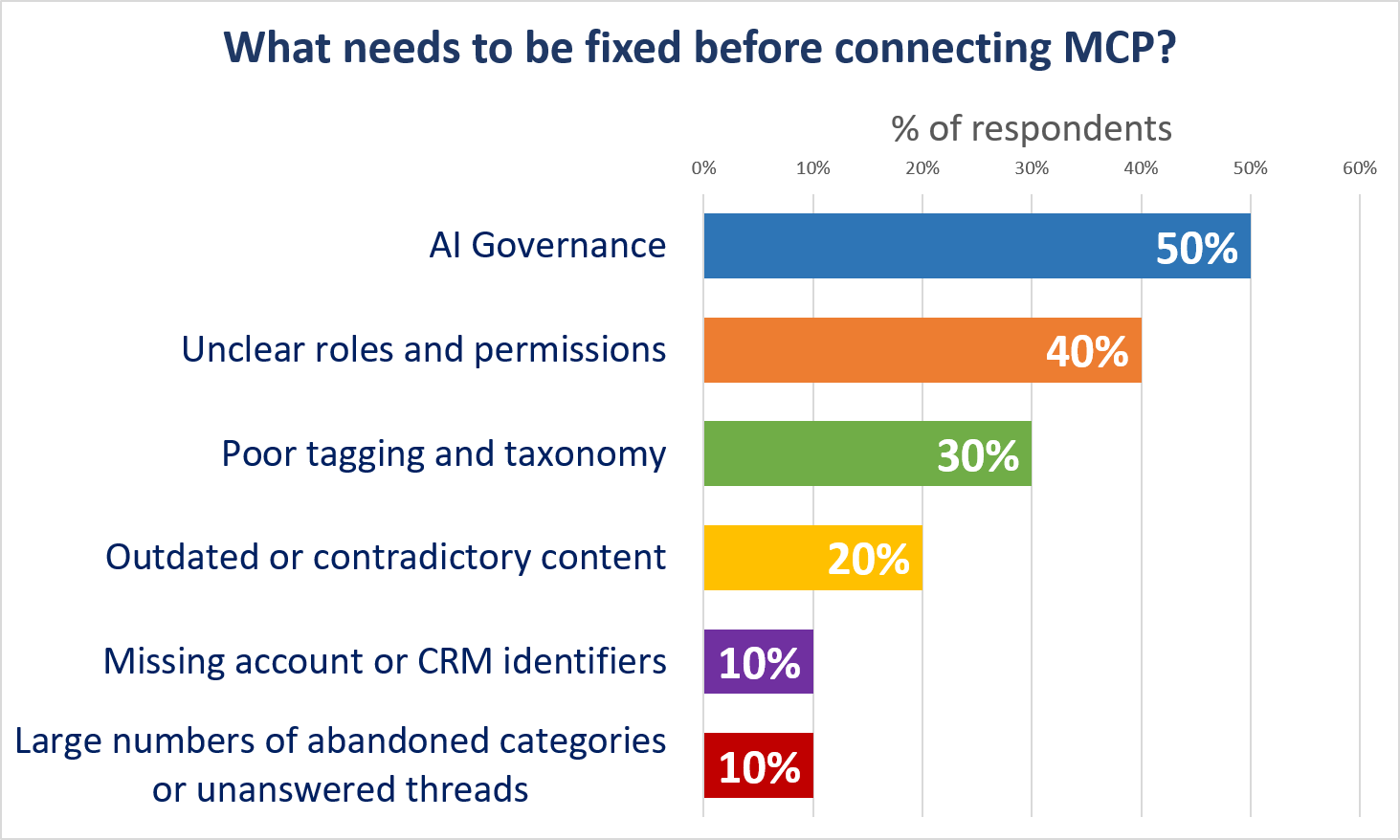
The group also explored what foundations need attention before connecting AI systems via MCP. Governance emerged as the leading concern, selected by 50% of participants. This was followed by unclear roles and permissions (40%) and weaknesses in tagging and taxonomy structures (30%). The results demonstrate that successful AI adoption depends as much on information architecture, governance and access management as it does on technology.
Start with read access before write access
One of the more practical recommendations from the session was to begin with "read" capabilities rather than immediately enabling AI to take actions.
Reading data, generating analyses, and surfacing insights is generally considered lower risk. Writing actions such as editing content, creating posts, changing settings, or deleting information require significantly stronger controls and human oversight.
Julian stressed the importance of maintaining a "human in the loop", especially for actions that directly impact members or community content. Several attendees agreed that AI suggestions can be incredibly valuable, but final decisions should remain with people.
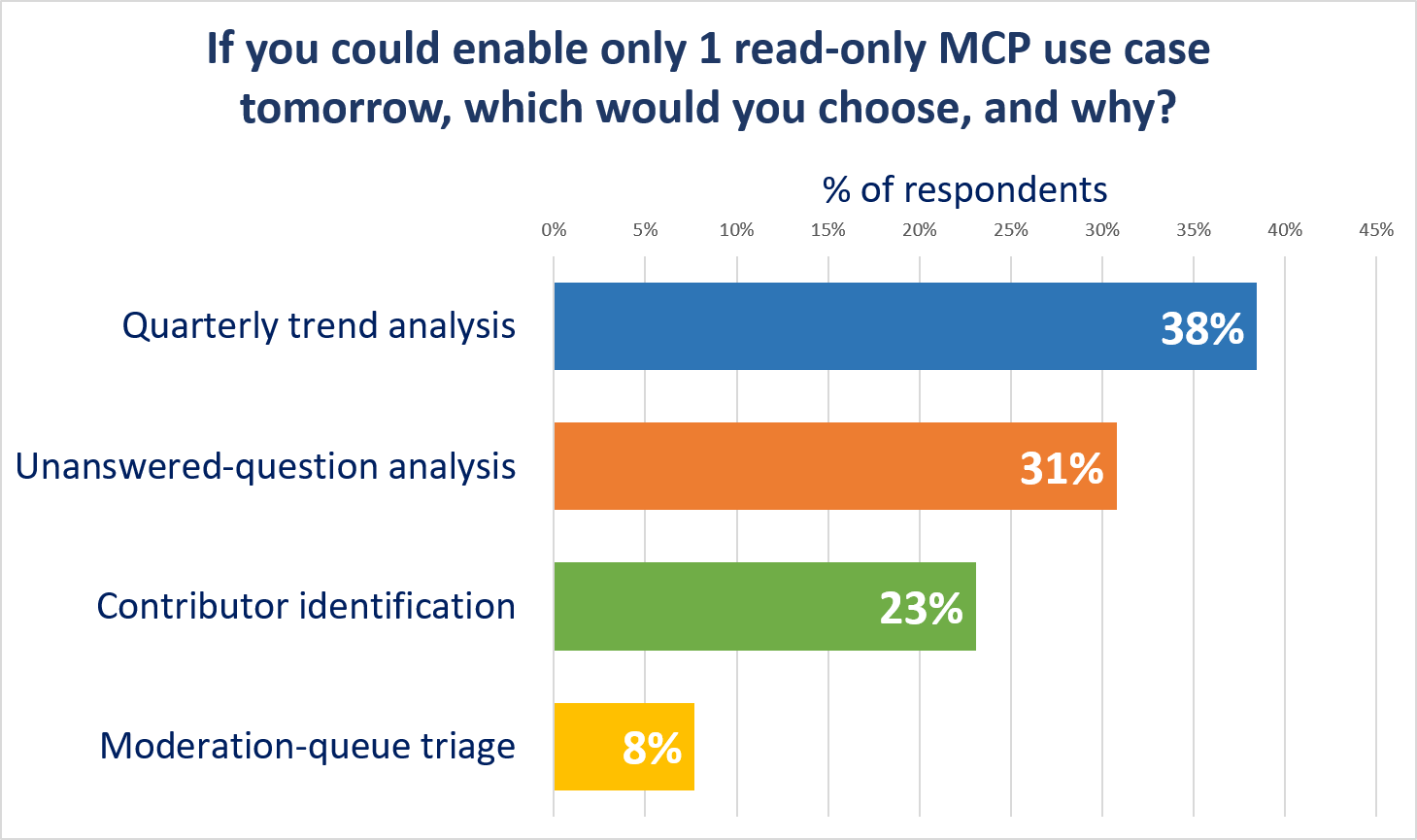
Asked to choose just one immediate read-only MCP use case, participants favoured quarterly trend analysis (38%), closely followed by unanswered-question analysis (31%). Contributor identification accounted for 23%, while moderation queue triage received less interest. The pattern suggests that community leaders currently see the greatest value in strategic insight and knowledge discovery rather than operational automation.
Communities should stay human
One of the most engaging discussions of the afternoon centred on an ethical question:
Should AI bots respond directly to community members?
Participants shared different perspectives and real-world experiments. Some organizations are already testing AI-generated responses for unanswered questions, particularly in large product communities where limited staff struggle to cover every conversation.
Julian offered a balanced view:
- AI can help surface relevant information.
- AI can suggest responses.
- AI can support moderators.
- AI should be clearly identifiable when it participates.
- Communities should remain places where humans connect with humans.
Transparency emerged as a key principle. If AI contributes content, members should know that they are interacting with AI-generated assistance rather than a person.
A new role for community managers
The conversation naturally led to the future of community management. If AI takes over reporting, moderation triage, content discovery, and routine administrative tasks, what remains for community professionals?
According to Julian, quite a lot. In fact, potentially more valuable work than ever before. Community managers are increasingly becoming:
- Relationship builders
- Community architects
- Content strategists
- Experience designers
- Super-user programme leaders
- Digital journey orchestrators
Rather than spending their days processing information, community managers can focus on creating experiences, facilitating knowledge sharing, and building stronger customer and member relationships.
What do attendees think is the main future focus of a community manager?
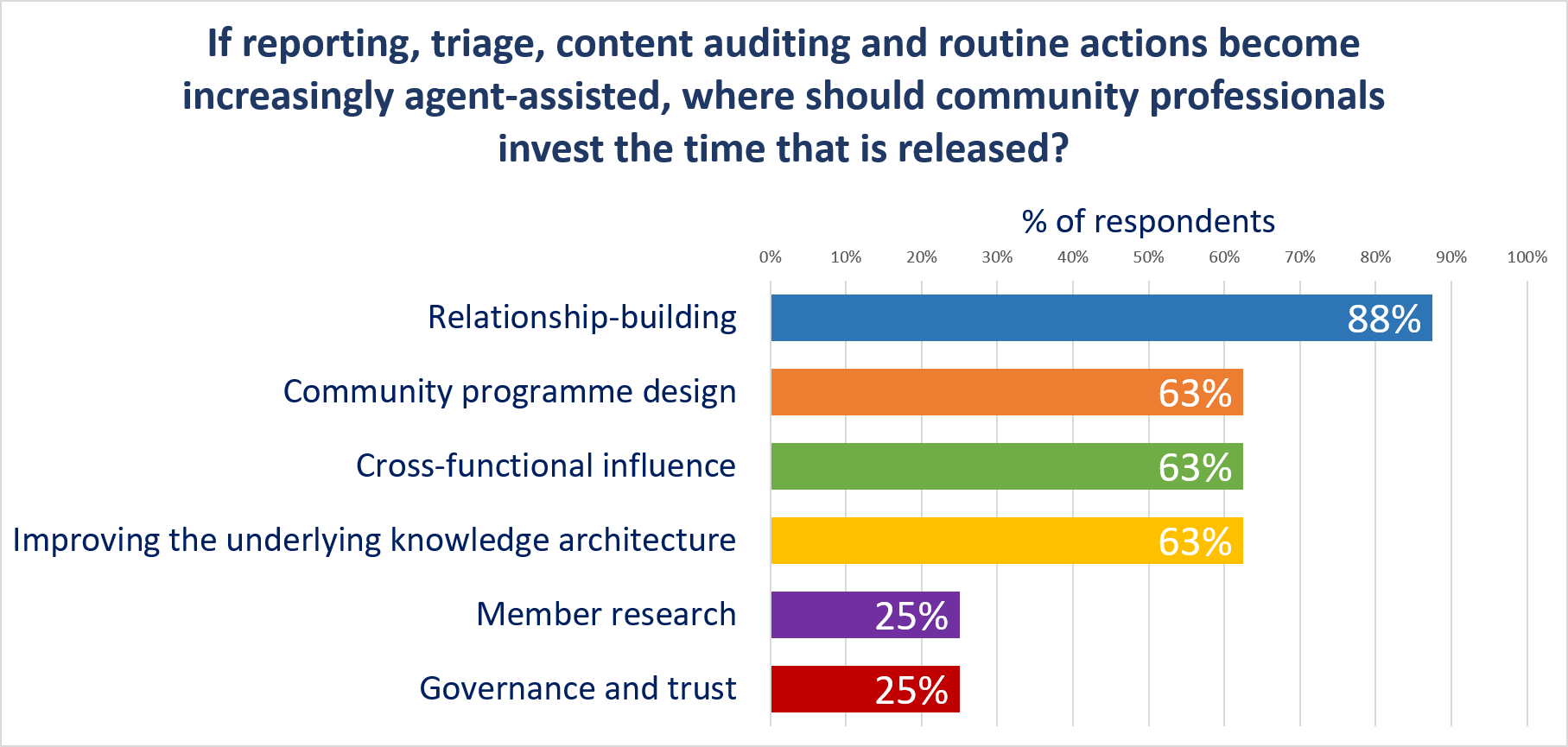
Perhaps the most telling result came when attendees considered what community professionals should focus on if AI increasingly handles reporting, triage and content auditing. Relationship-building emerged as the clear leader at 75%, followed by community programme design, cross-functional influence and knowledge architecture improvements, each selected by 63% of respondents. The message was clear: as automation grows, the value of human expertise shifts toward strategy, influence, trust and meaningful member relationships rather than routine administrative work.
Practical advice for getting started
For community professionals looking to begin exploring MCPs and AI, the session provided several practical recommendations:
- Start with a low-risk MCP integration.
- Focus on reporting and analytics use cases first.
- Keep humans involved in approval workflows.
- Review permissions and governance carefully.
- Be transparent with members about AI usage.
- Identify one repetitive task you would happily never do again and explore how AI could help automate it.
As Julian put it, the best starting point may simply be asking:
"What's the most annoying task I have in my community manager life these days, and how can I use AI and MCP to eradicate that from my daily task list?"
Looking ahead
The session left attendees with a realistic but optimistic view of the future. While governance, compliance, and organisational maturity remain important challenges, MCPs offer a compelling opportunity to unlock community data, eliminate manual effort, and enable entirely new ways of working.
For community leaders, the message was clear: don't start by trying to automate everything. Start by understanding where AI can remove friction, create insights, and give community professionals more time to focus on what communities do best: people helping people.