Rethinking community visibility in the age of AI


Insights from our latest Community Leaders Forum Meetup
At our latest Community Leaders Forum (CLF) Meetup, one of our members shared his early, hands‑on insights into a question many community teams are now grappling with:
What happens when AI systems use community content to answer questions before anyone clicks through to the community itself?
As AI agents like ChatGPT and Copilot increasingly surface answers directly in their interfaces, community content is being discovered, cited and consumed in new ways. Rather than framing this shift purely as a loss of traffic, the session encouraged community leaders to see AI visibility as a new layer of authority, trust and influence. And this layer often happens before a visit ever takes place.
Key takeaways from the meetup
- AI platforms already use community content in multiple ways, including model training, discovery and citation, and real‑time answer generation.
- Community Leaders are mostly just embarking on this AI journey. More practical frameworks and tactics are much needed.
- Traditional metrics such as page views and click‑through rates no longer capture the full value communities deliver.
- Open, discoverable communities may lose some clicks, but gain visibility and credibility inside AI‑assisted journeys.
- There is a growing need for better reporting and alignment between community, SEO, marketing and technical teams.
- Many best practices for AI citation still closely resemble strong SEO fundamentals.
A closer look at how AI traffic reaches community platforms
One of the most valuable contributions from the session was the distinction between three types of AI‑related traffic.
First, there is model‑training traffic, where bots crawl content to improve underlying AI systems. Second, discovery and citation traffic, where content is indexed so it can be referenced in AI‑generated answers. Third, real‑time interaction traffic, where an AI system fetches content while responding live to a user query.
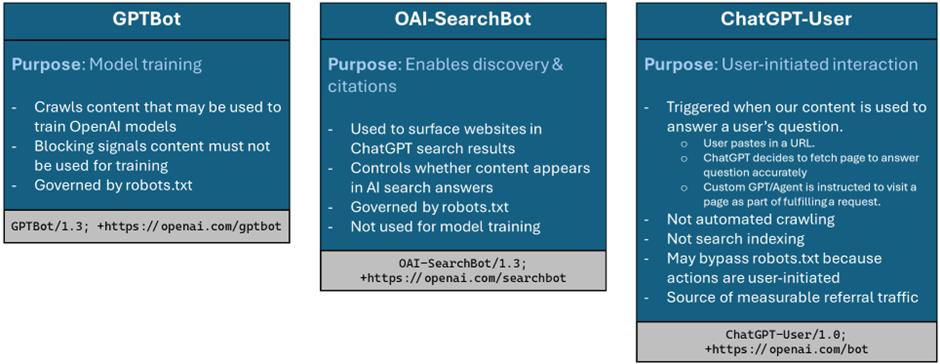
This framing helps shift the conversation away from a simple “traffic lost to AI” narrative. If communities are being cited as trusted sources within AI experiences, much of their value is now created before a website visit happens at all. A decline in direct clicks can exist alongside an increase in invisible — but meaningful — visibility. What is important, is if your community content should be discovered, you want it also to be cited.

The group also explored whether fewer clicks might actually lead to higher‑quality visits. Users who arrive after seeing a community cited in an AI answer may be more informed, more intentional, and closer to action than traditional search visitors.

Why community teams need a new measurement model
The speaker’s organisation already tracks familiar community metrics such as participation, weighted engagement, registrations and revenue influence. What is still missing, however, is a reliable way to connect those outcomes back to AI‑driven discovery and citation activity.
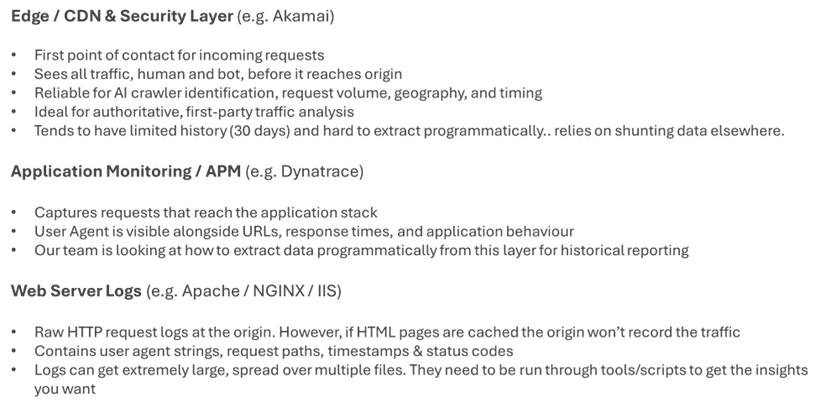
To explore this gap, the team examined existing technical data sources, including Akamai and Dynatrace. While the analysis was largely manual, it demonstrated that AI traffic patterns can be observed — and that automation and better dashboards are the next critical step if these insights are to scale.
As a practical starting point, Bing Webmaster Tools’ AI performance dashboard was highlighted. While it does not show the full picture, it provides an accessible entry into understanding citations, cited pages and grounding queries linked to Copilot traffic.
Should communities stay open to AI crawling?
One of the most strategic discussions in the meetup focused on whether communities should restrict AI bots or remain open. Let’s be clear: gated communities risk disappearing entirely from AI results. For public communities that contribute to brand credibility and expert discovery, that may be too high a price to pay.
At the same time, openness is not without trade‑offs. Infrastructure costs, performance impacts and operational strain all need to be considered. The emerging consensus leaned toward managed openness: remain discoverable where possible, monitor impact carefully, and avoid blocking AI visibility without a clear strategic reason.
What this means for content strategy
For community professionals hoping to improve AI citation and visibility, the advice was reassuringly familiar. Human‑readable URLs, clear page titles, strong structure, fresh content and tight alignment between page topic and copy all continue to matter.
If anything, AI discovery reinforces — rather than replaces — good SEO and content fundamentals.
The bigger challenge may be internal. Community leaders increasingly need to help stakeholders understand that declining clicks alone are no longer a reliable measure of success. If community content is shaping AI answers, influencing discovery earlier in the journey and strengthening brand trust, then our measurement frameworks must evolve accordingly.
Why this conversation matters now
This CLF Meetup made one thing clear: community teams are entering a new era of visibility. Influence can happen without a visit, authority can be built through citation, and value is increasingly created upstream of traditional engagement metrics.
As AI continues to reshape discovery, community leaders have an opportunity and a responsibility to redefine how success is measured and communicated inside their organisations.
We’ll continue exploring these shifts in future Community Leaders Forum sessions. If AI visibility, community measurement or discoverability is high on your agenda, we’d love to welcome you to a future meetup and continue the conversation.