Designing for inequality (on purpose!)


Part of a 3-part articles series
Small by design: Intimate enough to share, large enough to learn
Online communities exhibit much diversity in both size and activity level. Some communities grow to a massive scale and thrive, whereas others remain small, and even wither.
Humans gained unprecedented power by building large-scale information networks, coordinated by shared stories and rules. Yet our capacity for meaningful, trust-based relationships remains cognitively bounded. Harari shows how imagined orders enable mass cooperation. Combine that with Dunbar’s social-cognitive limits, Granovetter’s Strong/Weak Ties theory, and evidence from online-community research, and a clear design pattern emerges: decentralized communities of small pods, loosely coupled through a lightweight shared story and interoperable rituals, outperform single mega-forums, especially for customer value, knowlede quality, and resilience.
Also read Stop Chasing Scale. Chase Trust. or Take your online community beyond the 1-9-90 particpation inequality.
Article #3
Designing for inequality (on purpose!)
Most communities sputter because they never cross the tipping point where replies beget replies. Online communities need a certain number of active, responsive members to ignite. Once they hit that critical mass, conversations flourish. Until they reach a saturation point. Understanding these dynamics can help build healthier, more engaging communities.
Activity follows three regimes: fragile below a platform-specific critical size, compounding above it, and saturating at larger scales. Your job is to manufacture responsiveness and push early cohorts through the phase transition quickly.
Accept inequality and shape it
The 90–9–1 pattern is a robust baseline: a small minority creates most content, a middle minority responds, and a majority observes. You can shift the curve by reducing activation energy and scaffolding contribution, but the skew will persist. Plan for it.
Contribution follows a power law. As communities scale, attention and contribution concentrate in a minority. Power‑law dynamics produce an ‘A‑list’ no matter how egalitarian the intent. This isn’t moral failure, it’s what happens when many people freely choose among many options. Community managers should plan for it. Design pathways that broaden the contributor base and route power constructively through pods, mentorship, and rotating facilitation.
Implication: Build explicit pathways for newcomers and ‘quiet regulars’ to graduate into higher‑impact roles without being crowded out by perennial super‑contributors.
The relationship between activity and size: critical size before collaboration becomes self‑sustaining
In a research using data collected from seven large online platforms, investigating the relationship between activity and size, the authors wanted to understand why some communities thrive and others fail, and whether there’s a predictable pattern behind this. The researchers found a consistent pattern in how community size relates to activity.
Community activity tends to follow 3 regimes with a sharp phase transition at a platform‑specific critical size.
Below it, activity is fragile, low and sporadic. People post occasionally, but conversations don’t really take off. The community requires more than 12 new users just to encourage community members to increase their posting rate by one additional message. Thus, the effect of community size on participation is very small.
Above it, interactions compound. Activity jumps as Members start interacting more, discussion trees/branches grow, and the community feels alive. The magic number (critical size) is between 20 and 100 members. For every 1 additional user, the average posting rate of each existing user increases by 1 additional message. The effect of size on participation is about 10 times stronger in Regime II than in Regime I.
At a higher size, activity saturates. Activity levels off. Adding more members doesn’t make people post more. The community is stable but doesn’t get much livelier.
This process dynamic explains why many promising spaces “sputter” for months and then suddenly take off.
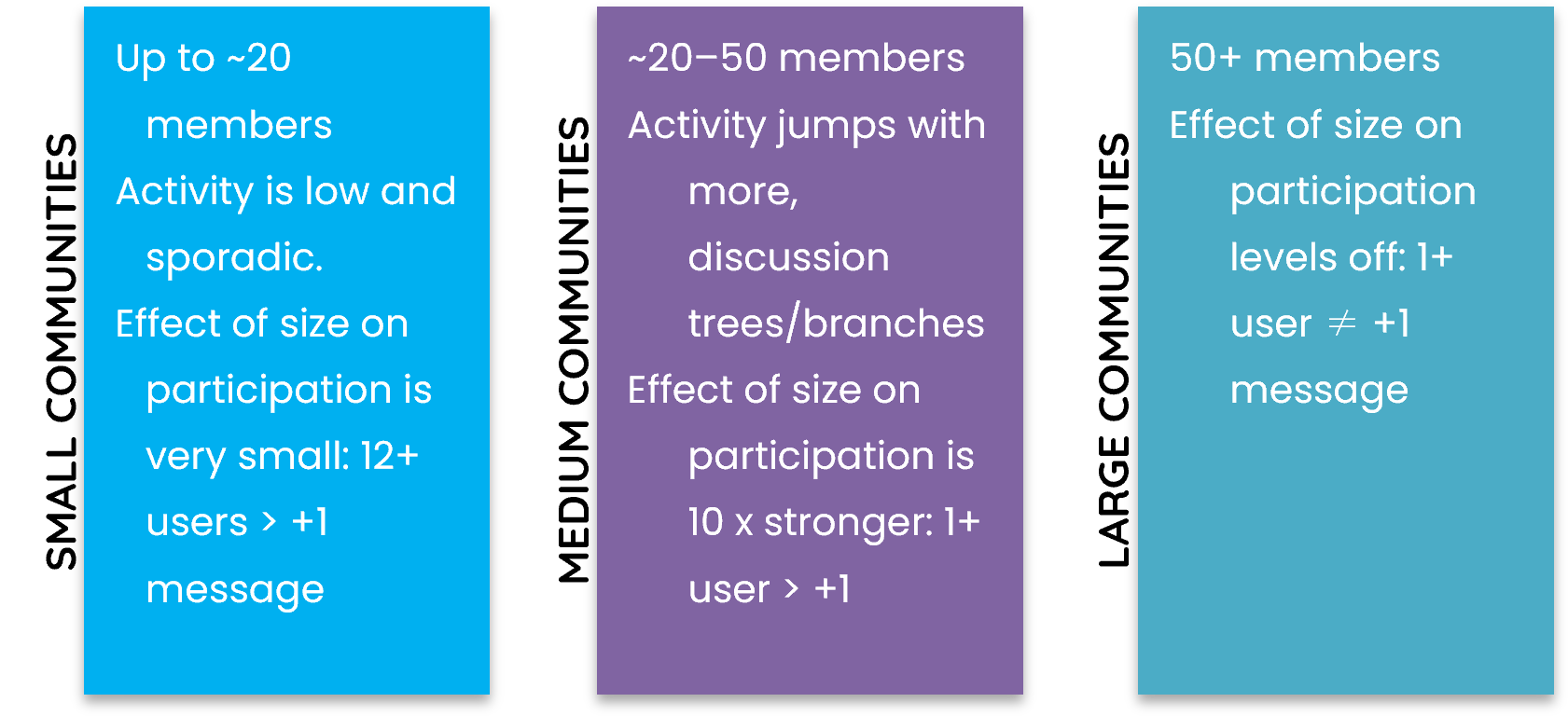
Implication: Critical mass is real: Communities need a minimum size to becomeself-sustaining. Responsiveness matters more than size: Encourage replies andengagement early. Growth isn’t endless: After a point, adding members won’t boost activity much.
Implication: Communities hit thresholds where interaction becomesself-sustaining, then later saturates; beyond that, adding more people doesn’t proportionally increase meaningful activity. This argues for multiple right-sized groups over one giant one.
Replies beget replies
Discussion trees explain how activity relates to responsiveness. Discussion trees consist of chains of messages and replies. Imagine a tree: The first post is the trunk. Replies are branches. Replies to replies make more branches.
If each post gets less than one reply on average, the tree stays small. If each post gets more than one reply, the tree grows fast. Eventually, growth slows because people can’t keep up.
The key factor here is responsiveness. How likely are members to reply?
- High responsiveness → critical size is small (even 3–4 members can spark activity).
- Low responsiveness → need a bigger group (100+ members on some forums).
After the critical point, activity grows fast, then slows as discussions saturate.
For anyone managing online communities this offers practical insights about minimum size, the effect on growth after a while, and that it is important to have the right type of members with a desired level of responsiveness. Member diversity and contribution inequality affect success.
Implication: Your launch strategy should deliberately push early cohorts past the critical mass (for your platform/context) a quickly as possible—via seeding, programming, and scheduled interactions—so replies beget replies.
Actionable moves
- Create pathways that turn Lurkers into Leaders.
- Micro-actions→ replies → posts →facilitation → mentorship: make each step easy and rewarded.
- Level-up badges and spotlight features for 'quiet regulars'. Recognize momentum before mastery.
- Inner guild of maintainers/moderators with explicit roles; rotate facilitation to expand voice.
Summary
- Inequality(1-9-90 rule) and Power Law shape unequal sociality in online communities.
- 3 regimes of platform specific critical size show relationship between size and activity.
- Replies beget replies so design for discussion trees.
- The characteristics of the people, the range of purposes they pursue, the type of governance policies they develop, require strategies to push towards the required level of responsiveness.
Research and further reading
- Community critical mass and activity regimes: Dover & Kelman (2018), PLOS ONE—your linked study on phase transitions in community activity across platforms. [journals.plos.org]
- Dunbar layers today: Dunbar’s 2021 reflection in The Conversation (defense and clarifications); a 2025 PLOS ONE paper explores individual differences in energy allocation across layers. Use as nuance, not gospel. [theconversation.com], [journals.plos.org]
- Strong/weak ties: Granovetter’s 1973 AJS classic; accessible reprints summarize the diffusion logic underpinning cross‑cluster engagement design. [jstor.org], [smg.media.mit.edu]
- Participation inequality: Wikipedia overview with peer‑reviewed health forum studies of “superusers”; Jake McKee/Nielsen practitioner resources; vendor challenge from Higher Logic with their dataset. [en.wikipedia.org], [cedma-europe.org], [higherlogic.com]
- Community evolution & adoption structure: Backstrom et al. (KDD’06) on group formation and how the structure of friends affects joining and growth. [snap.stanford.edu]
- Modularity & sub‑communities: accessible introductions to community detection, modularity, and its limits—useful for deciding when and how to create/merge sub‑groups. [dshizuka.github.io]
- Evidence‑based design playbook: Building Successful Online Communities (Kraut & Resnick, MIT Press)translates social science into practical design claims on contributions, commitment, regulation, and onboarding—essential shelf reference. [direct.mit.edu]
- Communities of Practice: Wenger‑Trayner’s guidance on size and participation levels; scholarly conversation with Wenger for theoretical grounding. [wenger-trayner.com], [eprints.wh...rose.ac.uk]
- Optimal group sizes for discussions: recent education research on pairs vs. triads/quads and guidance for online course forums (small groups persist; 50+ feels “very large”). [files.eric.ed.gov], [sites.google.com]
- Power laws & inequality in attention: Clay Shirky’s seminal essay—why inequality of visibility is structural and how to design around it. [cs.kent.edu]
- Harari’s “imagined orders”: Sapiens (2014 English; accessible summaries) for the narrative engine enabling cooperation at scale. [en.wikipedia.org], [connecting...smedia.com]
Read the other articles in this 3 part series:
#1 Stop Chasing Scale. Chase Trust.
#2 Take your online community beyond the 1-9-90 participation inequality