Stop Chasing Scale. Chase Trust.


Part of a 3-part articles series
Small by design: Intimate enough to share, large enough to learn
Online communities exhibit much diversity in both size and activity level. Some communities grow to a massive scale and thrive, whereas others remain small, and even wither.
Humans gained unprecedented power by building large-scale information networks, coordinated by shared stories and rules. Yet our capacity for meaningful, trust-based relationships remains cognitively bounded. Harari shows how imagined orders enable mass cooperation. Combine that with Dunbar’s social-cognitive limits, Granovetter’s Strong/Weak Ties theory, and evidence from online-community research, and a clear design pattern emerges: decentralized communities of small pods, loosely coupled through a lightweight shared story and interoperable rituals, outperform single mega-forums, especially for customer value, knowlede quality, and resilience.
Aso read Take your online community beyond the 1-9-90 participation inequality and Designing for inequality (on purpose!).
Article #1
Stop Chasing Scale. Chase Trust.
If your customer community strategy still worships raw membership growth, you’re playing the wrong game. The human social brain sets a ceiling on meaningful ties. Smart leaders design communities that are small by design: right-sized pods nested under an umbrella narrative, so members build trust, exchange expertise, and keep coming back.
Yes, size matters!
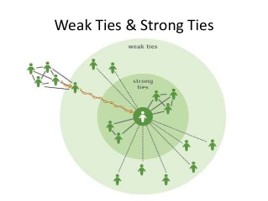
And mostly which size. According to Robin Dunbar, people can only maintain a finite set of meaningful relationships, typically organized in layered circles (~5/15/50/150). That’s a limit on ongoing, reciprocal ties, not on acquaintance counts. The key is quality of tie, not the raw count of connections. This provides a cognitive/attention ceiling for ongoing, reciprocal relationships in any one context. Once the active base approaches ~150–200, expecting all-to-all bonding in a single forum is fantasy.
What is the importance of these constraints in limiting human online sociality? Can it or can it not allow larger networks to be maintained? Maybe not, because only relatively weak quality relationships can be maintained without face-to-face interaction? Online interactions often lack physical co-presence and emotional bonding cues. Laughter and physical interaction trigger bonding mechanisms (endorphins), which is more difficult to replicate effectively online.
Implication: Don’t expect all‑to‑all bonding in a single, undifferentiated community once you move much beyond ~150–200 active members. Segmenting into sub‑groups preserves intimacy without sacrificing scale.
Design for strong and weak ties to stimulate growth & engagement
Strong ties drive trust and willingness to help. Weak ties bridge clusters and inject novelty. Healthy communities intentionally cultivate both: small recurring circles (pods, cohorts) for psychological safety and cross-group programming (AMAs, mixers, randomized coffees) for serendipity and diffusion.
An operating model for layered engagement
Even in large online communities, members can only maintain meaningful engagement with a limited number of people and topics. A massive, undifferentiated community risks low engagement because members cannot form strong bonds. Smaller, focused sub-groups (e.g., by product, interest, geography/location, or role) allow members to build deeper connections within their cognitive capacity. These sub-groups mimic Dunbar’s layers: a few close peers in a niche group, broader connections in larger forums. Large umbrella communities serve as bridging networks, enabling weak ties and information flow across sub-groups. These weak ties are valuable for knowledge sharing and innovation but do not replace strong emotional bonds.
In-person meetups, conferences, and workshops activate bonding mechanisms (endorphins,trust-building) that digital interactions cannot replicate. These events strengthen the inner layers of the network, making online engagement more resilient.
The strategy should focus on layered engagement.
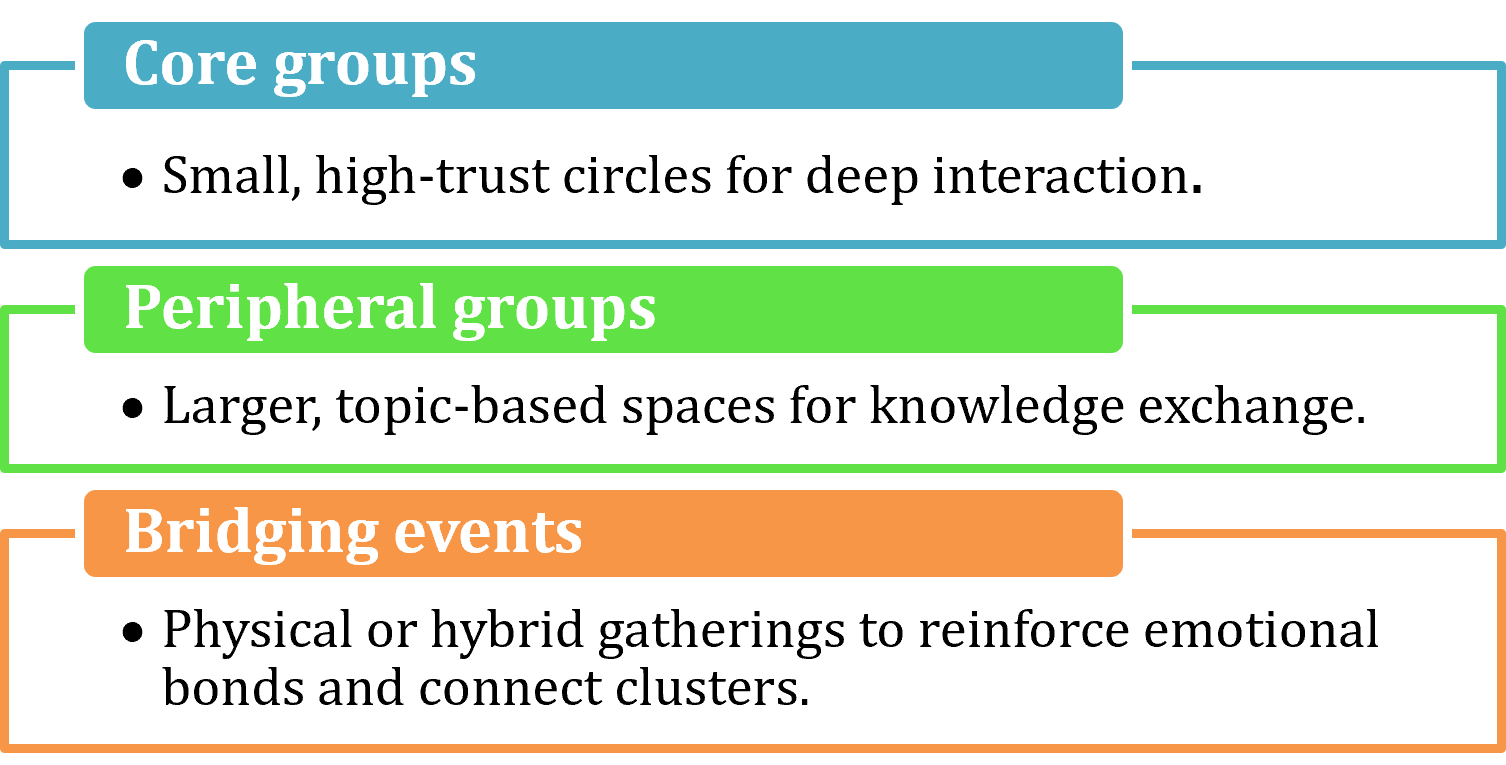
If you’re still celebrating a single global forum with ‘thousands of members’, you’re optimizing for vanity metrics. Optimize for trust density and cross-cluster bridges instead. Your community’s health lives in the quality of sustained ties and the engineered collisions between pods; not in the size of your email list.
Actionable moves
- Spin-up 3 to 6 working circles of 4 to 8 people around jobs-to-be-done.
- Standup a Rapid-Response Crew to guarantee a substantive first reply within 24 hours on newcomer posts.
- Introduce low-effort actions (reactions, polls) and templates that nudge lurkers into light contribution.
- Schedule an anchor event (e.g., AMA, Q&A, or “Member-hosted Show & Solve” session).
- Blend strong/weak ties and enforce triadic closure in onboarding to increase stickiness.
- Architect for responsiveness using a lobby, neighbourhoods, and boulevards.
Failure modes & fixes (Reality Check)
- Premature fragmentation: consolidate until each forum reliably crosses activity thresholds; use temporary tags before permanent areas.
- Stalled launch: timebox a relaunch sprint with a seed cohort, high-density interaction windows, and guaranteed first replies.
Summary
- Design for intimacy first; scale via nested pods under a clear narrative.
- Balance strong ties (trust) and weak ties (novelty) with recurring circles and cross-pod programming.
- Reinforce emotional bonds through physical gatherings.
- Use subgroups once active members approach ~150–200 to preserve meaningful engagement.
Research and further reading
- Community critical mass and activity regimes: Dover & Kelman (2018), PLOS ONE—your linked study on phase transitions in community activity across platforms. [journals.plos.org]
- Dunbar layers today: Dunbar’s 2021 reflection in The Conversation (defense and clarifications); a 2025 PLOS ONE paper explores individual differences in energy allocation across layers. Use as nuance, not gospel. [theconversation.com], [journals.plos.org]
- Strong/weak ties: Granovetter’s 1973 AJS classic; accessible reprints summarize the diffusion logic underpinning cross‑cluster engagement design. [jstor.org], [smg.media.mit.edu]
- Participation inequality: Wikipedia overview with peer‑reviewed health forum studies of “superusers”; Jake McKee/Nielsen practitioner resources; vendor challenge from Higher Logic with their dataset. [en.wikipedia.org], [cedma-europe.org], [higherlogic.com]
- Community evolution & adoption structure: Backstrom et al. (KDD’06) on group formation and how the structure of friends affects joining and growth. [snap.stanford.edu]
- Modularity & sub‑communities: accessible introductions to community detection, modularity, and its limits—useful for deciding when and how to create/merge sub‑groups. [dshizuka.github.io]
- Evidence‑based design playbook: Building Successful Online Communities (Kraut & Resnick, MIT Press)translates social science into practical design claims on contributions, commitment, regulation, and onboarding—essential shelf reference. [direct.mit.edu]
- Communities of Practice: Wenger‑Trayner’s guidance on size and participation levels; scholarly conversation with Wenger for theoretical grounding. [wenger-trayner.com], [eprints.wh...rose.ac.uk]
- Optimal group sizes for discussions: recent education research on pairs vs. triads/quads and guidance for online course forums (small groups persist; 50+ feels “very large”). [files.eric.ed.gov], [sites.google.com]
- Power laws & inequality in attention: Clay Shirky’s seminal essay—why inequality of visibility is structural and how to design around it. [cs.kent.edu]
- Harari’s “imagined orders”: Sapiens (2014 English; accessible summaries) for the narrative engine enabling cooperation at scale. [en.wikipedia.org], [connecting...smedia.com]
Read the other articles in this 3 part series:
#2 Take your online community beyond the 1-9-90 participation inequality
#3 Designing for inequality (on purpose!)