Take your online community beyond the 1-9-90 participation inequality


Part of a 3-part articles series
Small by design: Intimate enough to share, large enough to learn
Online communities exhibit much diversity in both size and activity level. Some communities grow to a massive scale and thrive, whereas others remain small, and even wither.
Humans gained unprecedented power by building large-scale information networks, coordinated by shared stories and rules. Yet our capacity for meaningful, trust-based relationships remains cognitively bounded. Harari shows how imagined orders enable mass cooperation. Combine that with Dunbar’s social-cognitive limits, Granovetter’s Strong/Weak Ties theory, and evidence from online-community research, and a clear design pattern emerges: decentralized communities of small pods, loosely coupled through a lightweight shared story and interoperable rituals, outperform single mega-forums, especially for customer value, knowlede quality, and resilience.
Aso read Stop Chasing Scale. Chase Trust. and Designing for inequality (on purpose!).
Article #2
Take your online community beyond the 1-9-90 participation inequality
Form triads with a blend of strong and weak ties and connect them though a compelling narrative.
Designing for participation inequality
The well‑known 1‑9‑90(or 90‑9‑1) rule describes that a small minority creates most content, a middle minority edits/responds, and a large majority lurks. It’s been documented across many platforms and in health forums with superusers. While some recent vendor datasets show higher participation in certain small communities, the skew remains a robust baseline. Use it as a starting assumption, not a destiny. Because with the right community design and tactics you can surpass these participation levels. Analysis from platform vendors (e.g., Higher Logic) suggest higher active rates, especially in smaller enterprise communities. Reminding us that design and context in your community practice can shift the curve.
Implication: Reduce the activation energy at each step: make low‑effort, low‑risk actions abundant (reactions, polls, templates), then scaffold progression to replies, posts, and leadership.
Cultivate both strong and weak ties
Mark Granovetter’s classic work showed weak ties bridge otherwise separate clusters, enabling novel information flow that strong ties rarely provide. In contrast, strong ties confer trust, commitment, and willingness to help. Vital for vulnerable sharing and co‑creation. Healthy communities cultivate both.
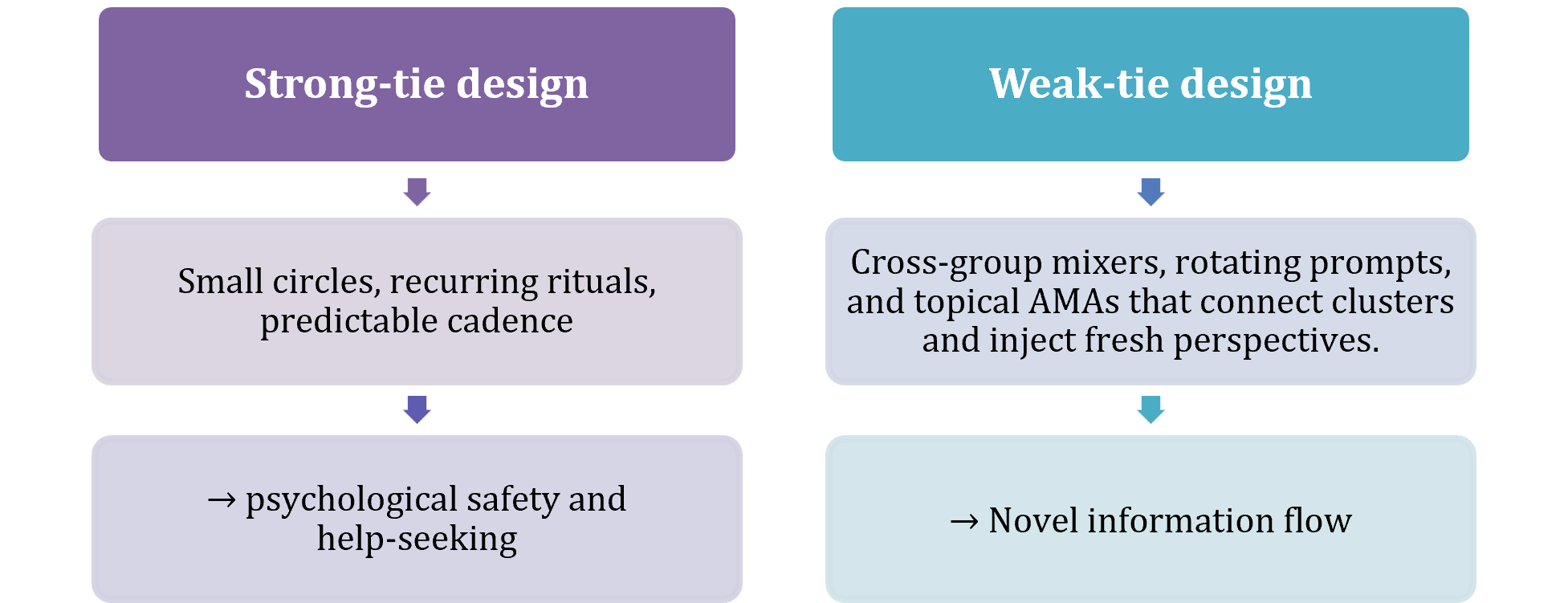
If you only have strong ties, the community becomes a tight-knit clique; safe but insular, with little innovation or diversity of thought. If you only have weak ties, you get lots of novelty but little trust as people hesitate to share openly or collaborate deeply. Healthy communities blend both: Strong ties keep members engaged and willing to invest effort. Weak ties keep the community dynamic, innovative, and resilient.
Triadic closure
Adoption and retention depend not just on how many friends someone has in the community, but whether those friends know each other. Who joins and stays depends on how a member’s friends are connected to one another, not just how many are inside. This so called triadic structure matters for adoption and growth:
If Alice knows Bob and Carol, and Bob knows Carol, Alice feels more embedded (stronger social fabric). If Alice knows Bob and Carol but they don’t know each other, her ties are weaker and she’s more likely to churn.
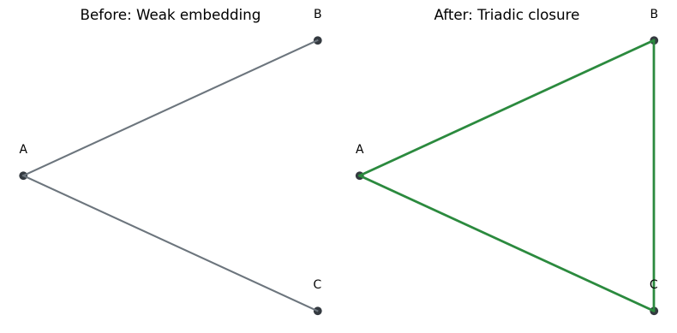
Closing triangles increases embeddedness and retention. Structure onboarding and rituals to make closure routine.
Implication: When onboarding new members, encourageintroductions and shared activities that close triangles. This strengthens thenetwork and increases stickiness.
Communities have a need for a compelling narrative
In Sapiens, Harari argues that humans coordinate at scale by believing in shared fictions or ‘imagined orders’ like money or mission. Humans thrive through stories.
Treat your community charter as product #1: a short, vivid story that explains why we gather, who we are for, and how we behave, then encode it in rituals (welcome posts, showcases, ceremonies) so it’s lived, not laminated.
Implication: your brand narrative, values, and participation rules are the ‘imagined order’ that make it possible for thousands of customers and partners to collaborate, even if they never meet. It is the non‑technical infrastructure that lets strangers collaborate.
Actionable moves
- Launch welcome/onboarding flows.
- Ask new joiners to write a personal welcome message.
- Prompt for a quick poll vote.
- Onboarding closes triangles: encourage introductions, connections so friends-of-friends become friends, strengthening fabric.
- Publisha one-page narrative charter and ritualize it in welcomes and showcases.
- Treat launch like an activation sprint; manufacture responsiveness to cross critical mass.
- Measure what matters: responsiveness and network structure, not vanity counts.
Summary
- Go beyond participation inequality
- Blend strong and weak ties
- Design for triadic closure, for these connections
Research and further reading
- Community critical mass and activity regimes: Dover & Kelman (2018), PLOS ONE—your linked study on phase transitions in community activity across platforms. [journals.plos.org]
- Dunbar layers today: Dunbar’s 2021 reflection in The Conversation (defense and clarifications); a 2025 PLOS ONE paper explores individual differences in energy allocation across layers. Use as nuance, not gospel. [theconversation.com], [journals.plos.org]
- Strong/weak ties: Granovetter’s 1973 AJS classic; accessible reprints summarize the diffusion logic underpinning cross‑cluster engagement design. [jstor.org], [smg.media.mit.edu]
- Participation inequality: Wikipedia overview with peer‑reviewed health forum studies of “superusers”; Jake McKee/Nielsen practitioner resources; vendor challenge from Higher Logic with their dataset. [en.wikipedia.org], [cedma-europe.org], [higherlogic.com]
- Community evolution & adoption structure: Backstrom et al. (KDD’06) on group formation and how the structure of friends affects joining and growth. [snap.stanford.edu]
- Modularity & sub‑communities: accessible introductions to community detection, modularity, and its limits—useful for deciding when and how to create/merge sub‑groups. [dshizuka.github.io]
- Evidence‑based design playbook: Building Successful Online Communities (Kraut & Resnick, MIT Press)translates social science into practical design claims on contributions, commitment, regulation, and onboarding—essential shelf reference. [direct.mit.edu]
- Communities of Practice: Wenger‑Trayner’s guidance on size and participation levels; scholarly conversation with Wenger for theoretical grounding. [wenger-trayner.com], [eprints.wh...rose.ac.uk]
- Optimal group sizes for discussions: recent education research on pairs vs. triads/quads and guidance for online course forums (small groups persist; 50+ feels “very large”). [files.eric.ed.gov], [sites.google.com]
- Power laws & inequality in attention: Clay Shirky’s seminal essay—why inequality of visibility is structural and how to design around it. [cs.kent.edu]
- Harari’s “imagined orders”: Sapiens (2014 English; accessible summaries) for the narrative engine enabling cooperation at scale. [en.wikipedia.org], [connecting...smedia.com]
Read the previous article in this 3 part series:
#1 Stop Chasing Scale. Chase Trust.
#3 Designing for inequality (on purpose!)